Jupiter in the birth chart
In a birth chart, Jupiter is associated with growth, opportunity, generosity, belief and the search for meaning. As a social body, it can describe how someone finds room to learn, trust and take part in wider ideas. Its sign and motion offer a symbolic language for considering how that drive tends to work, not a promise of specific events.
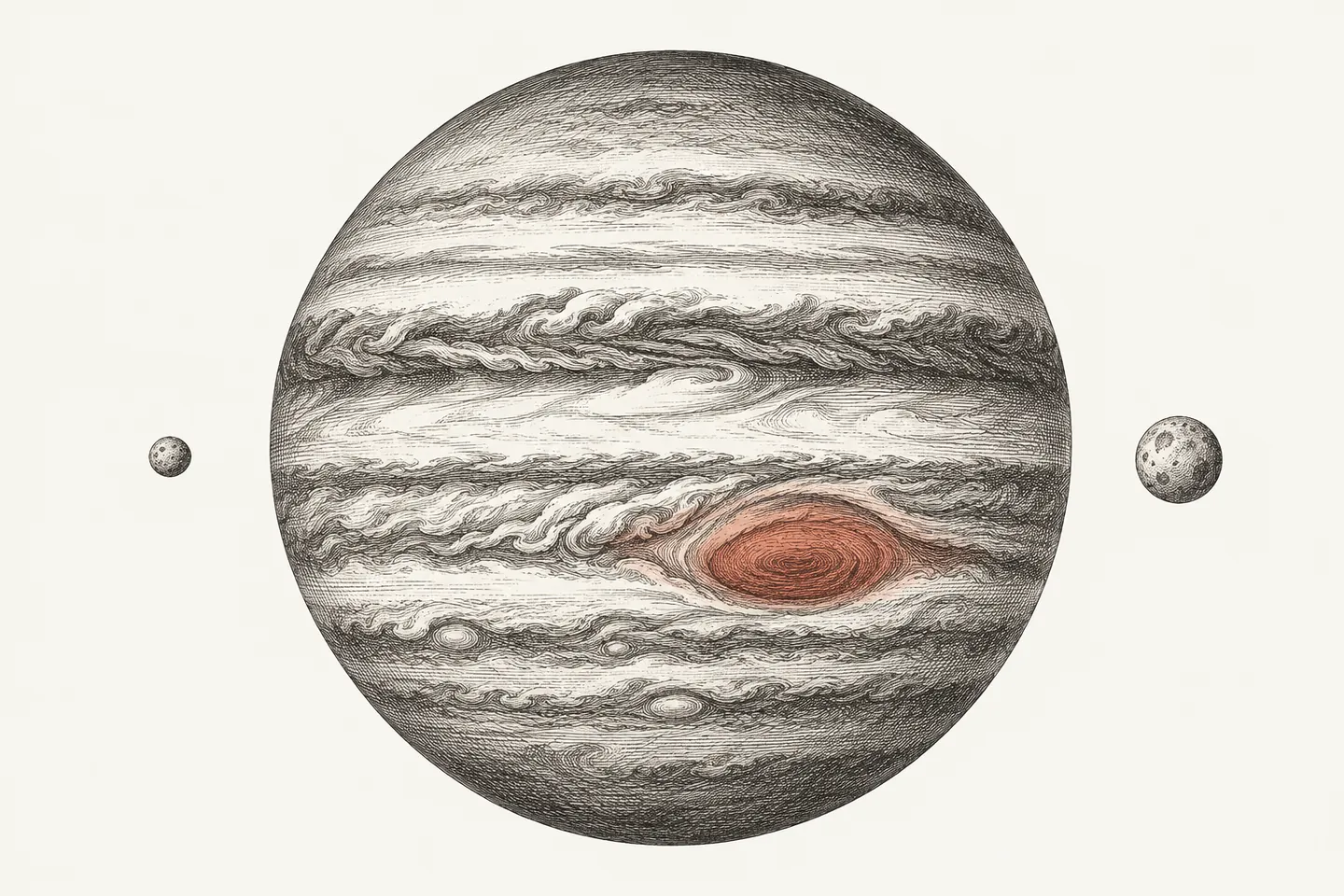
Jupiter at a glance
- Symbol
- Jupiter
- Kind
- Social planet
- Rules
- Sagittarius
- Time in a sign
- 1 years
- Shortest to longest stay
- 0.4 years to 1.1 years
- Retrograde
- 30.1% of the time
- Turns a year
- 0.91 times
Cycle figures computed on November 9, 2026. The site's own ephemeris series, sampled every 2 days from 2000-01-01 to 2099-12-31 (101 complete stays in a sign). A stay runs from the first time the body reaches a sign's start to the first time it reaches the next sign's start, so a retrograde step back over a border is part of the stay. Retrograde means the ecliptic longitude is falling between two samples.
Jupiter’s expansive orbit
Jupiter is the largest planet, bright and steady in the sky, with four large moons visible in a small telescope. In astrology, it is a social body associated with growth, opportunity, belief, generosity and the search for meaning. Its themes reach beyond private needs: Jupiter can point to how a person makes sense of life, shares what they believe and looks for room to grow.
Jupiter circles the Sun in about 11.9 years, spending about a year in each sign. That pace gives it a broader social rhythm than the faster-moving personal planets. Astrologers may connect its sign with the outlook and shared beliefs of people born around the same period. In an individual chart, Jupiter’s meaning is considered alongside its house and aspects, but its central theme remains expansion through trust, learning and purpose.
Traditional sign dignities
In the traditional scheme, Jupiter is at home in Sagittarius and Pisces, exalted in Cancer, in detriment in Gemini and Virgo, and in fall in Capricorn. “At home” and “exalted” describe placements where Jupiter’s qualities are traditionally considered supported. Detriment and fall describe more effortful settings for its style of growth.
The same wish to learn can look frank and adventurous in Sagittarius, where Jupiter is at home, and restless in Gemini, where it is in detriment. In Sagittarius, interest may gather around a broad belief or journey; in Gemini, it may branch into many questions and conversations. The traditional labels describe different conditions for Jupiter’s drive, not a judgment of someone’s worth or a fixed outcome.
Growth in everyday life
In ordinary life, Jupiter may show up as enthusiasm for study, travel, teaching, faith or generous exchange. Someone may look for meaning in a new subject, share an opportunity, or give others room to try. Jupiter’s reach can also become excess: confidence may outrun evidence, or generosity may stretch beyond what is practical. These are possibilities for reflection, not predictions about a person’s choices.
Jupiter turns retrograde once a year, for about four months. In astrology, that period can be used to consider beliefs and opportunities more privately, as a review of what feels meaningful rather than a sign that growth stops. Retrograde describes how the planet appears to move from Earth; it does not establish what a person must experience. Jupiter’s usual themes of faith and expansion remain relevant in interpretation.
Questions
Why does Jupiter spend about a year in each sign?
Jupiter circles the Sun in about 11.9 years, so its passage through the zodiac is much slower than that of the personal planets. It spends about a year in each sign. Astrologers use this pace to connect Jupiter with wider social themes as well as an individual’s search for meaning.
What does Jupiter retrograde mean in astrology?
Jupiter turns retrograde once a year for about four months. Astrologically, this apparent backward motion is often associated with reviewing beliefs, plans for growth and ideas about opportunity. It does not mean that progress must stop or that a specific event is due.
Why is Jupiter exalted in Cancer?
In the traditional dignity scheme, Jupiter is exalted in Cancer. This is treated as a supportive placement for its themes of generosity and growth, expressed through Cancer’s protective, emotional and nurturing style. The label is an interpretive tradition, not a measure of character or a prediction.
Which signs are traditionally ruled by Jupiter?
Jupiter rules Sagittarius in the traditional scheme and is also traditionally at home in Pisces. Modern rulerships associate Pisces with Neptune, while Uranus is linked with Aquarius and Pluto with Scorpio.
Find your Jupiter
Enter your birth details to see Jupiter in your chart: its sign, its house and whether it is retrograde.
Plate 1. Birth details
Example chart: 15 June 1990, 14:30, London (an invented birth, not a real person)
Plate 2. Find yours
Jupiter in the example chart
This is the example chart. Enter your details above to see yours.
- Sign
- Cancer
- Degree
- 15°54'
- House
- 10th house
- Motion
- Direct
In sign
Jupiter in Cancer
Generosity and opportunity can show up through caring for people and making space feel safe. You may trust what feels familiar, yet guardedness can limit how readily you consider a different way forward.
In house
Jupiter in the 10th house
Career and public life can become settings for growth, opportunity, and a sense of purpose. You may aim high in your long-term role, though a broad vision can sometimes make the next practical step less clear.