Pluto in the birth chart
In a birth chart, Pluto is associated with transformation, power, intensity, endings and renewal, and what runs deep. As an outer body, it moves slowly through the zodiac, so its sign can describe a shared generational tone. Its house and aspects can make its themes more personal. Astrology uses Pluto as a symbolic language for reflection, not as proof or prediction.
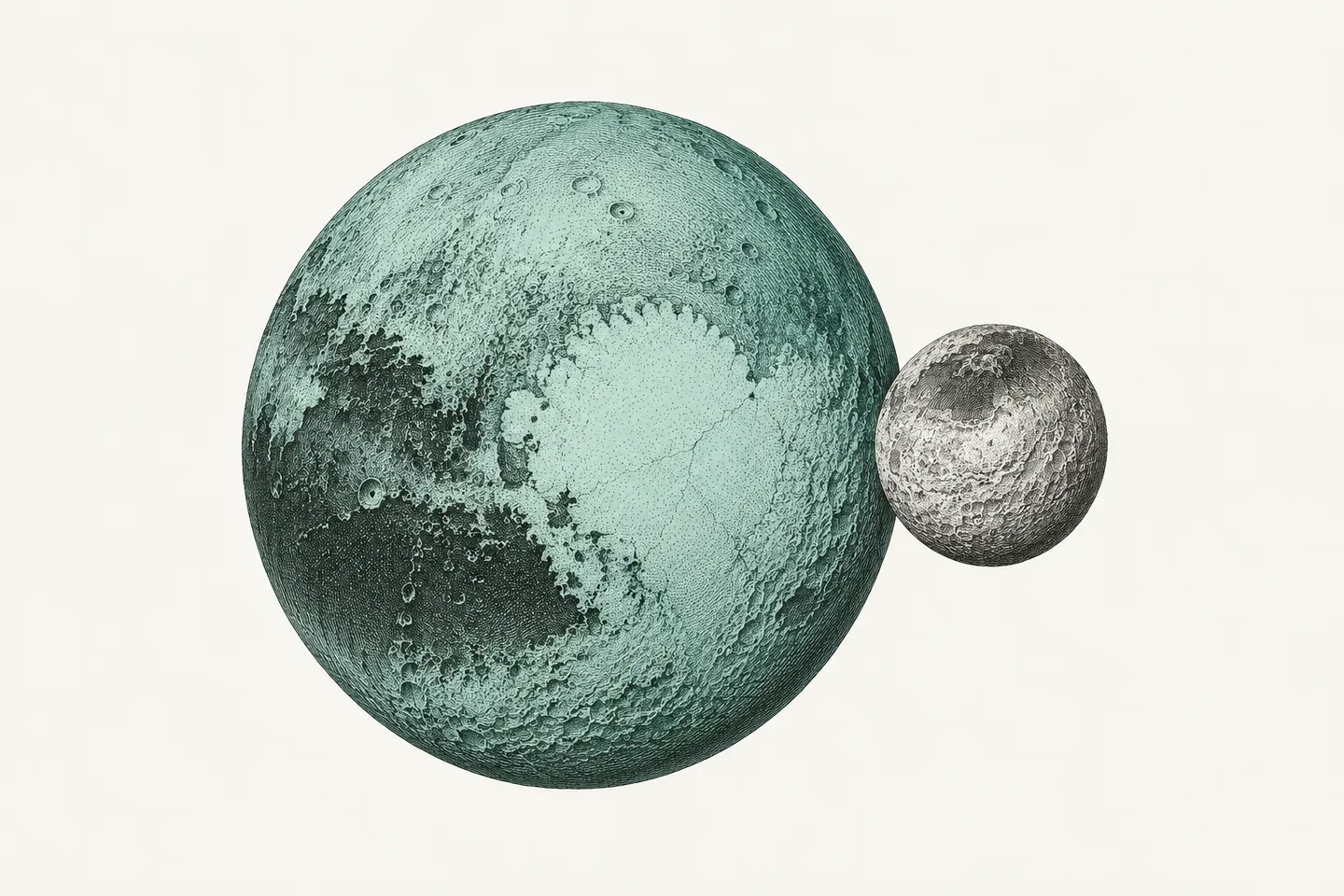
Pluto at a glance
- Symbol
- Pluto
- Kind
- Outer planet
- Rules
- Scorpio
- Time in a sign
- 21.8 years
- Shortest to longest stay
- 15.2 years to 29 years
- Retrograde
- 44.7% of the time
- Turns a year
- 1 times
Cycle figures computed on November 9, 2026. The site's own ephemeris series, sampled every 2 days from 2000-01-01 to 2099-12-31 (4 complete stays in a sign). A stay runs from the first time the body reaches a sign's start to the first time it reaches the next sign's start, so a retrograde step back over a border is part of the stay. Retrograde means the ecliptic longitude is falling between two samples.
A slow outer body
Pluto is an outer body associated with transformation, power, intensity, endings and renewal, and what runs deep. It was discovered in 1930 and has been classed as a dwarf planet since 2006. Its orbit around the Sun takes about 248 years, so it moves far more slowly than the planets closer to Earth. In astrology, this slow pace gives Pluto's sign a broad, generational quality.
Its orbit is tilted and stretched, and that uneven path means Pluto spends from about twelve to thirty years in a sign. A person’s Pluto sign is therefore often shared by people born across a wide span of years. That does not make its themes identical for everyone: its place in a chart can bring them into more personal focus. Astrologers use this outer body to consider deep pressures, major endings and the possibility of renewal.
Modern rulership, no traditional dignities
The traditional dignity scheme does not cover Pluto, because Pluto is a modern planet. In that scheme it has no traditional home, exaltation, detriment or fall. Modern astrology gives Pluto rulership of Scorpio. That is a later association, rather than a traditional dignity. So labels such as “exalted Pluto” or “Pluto in fall” are not established traditional placements.
The same drive to reach what lies beneath can look searching and all-or-nothing in Scorpio, Pluto’s modern sign of rulership. In Taurus, whose manner is steady, patient and practical, that drive may show as a stubborn effort to hold on through change. This comparison describes different styles, not a traditional dignity ranking. Pluto’s traditional status remains the same in both signs: the scheme assigns it no dignities.
Deep themes in daily life
In ordinary life, Pluto may point to strong feelings about control, privacy, trust or change. A person might notice its themes when an old role ends, a hidden concern comes into view, or a difficult transition calls for a new way forward. These are possible areas for reflection, not predictions. Pluto’s slow movement also means its sign tends to describe a generation, while its house and aspects can connect the theme with personal experience.
Pluto turns retrograde once a year for about five months. In astrology, a retrograde period is often treated as a time when Pluto’s themes may feel more inward or call for review. It does not by itself signal an event. The Sun and Moon never turn retrograde. The Sun instead has a central role in chart interpretation, while the Moon’s phases describe its changing visible shape in the sky.
Questions
Why does Pluto stay in one sign for so many years?
Pluto circles the Sun in about 248 years. Its tilted, stretched orbit makes its time in each sign uneven, from about twelve to thirty years. As a result, many people born during the same broad period share a Pluto sign, which astrologers connect with generational themes.
What makes Pluto different from the traditional planets?
Pluto is an outer body and has been classed as a dwarf planet since 2006. Its orbit is much longer than those of the planets closer to Earth, and it spends years in each sign. Astrology links this slow movement with deep, broad changes that can mark a generation.
Does Pluto have an exaltation or a traditional fall?
No. Pluto is a modern planet, so the traditional dignity scheme gives it no home, exaltation, detriment or fall. Modern astrology associates it with Scorpio as a ruler. This is a modern assignment, not a traditional dignity classification.
What does Pluto retrograde mean in a birth chart?
Pluto turns retrograde once a year for about five months. Astrologers may interpret this period as a more inward review of Pluto themes, such as power, endings and renewal. A retrograde period is not a prediction of an event, and it does not change Pluto’s slow orbit through the signs.
Find your Pluto
Enter your birth details to see Pluto in your chart: its sign, its house and whether it is retrograde.
Plate 1. Birth details
Example chart: 15 June 1990, 14:30, London (an invented birth, not a real person)
Plate 2. Find yours
Pluto in the example chart
This is the example chart. Enter your details above to see yours.
- Sign
- Scorpio
- Degree
- 15°24'
- House
- 2nd house
- Motion
- Retrograde
In sign
Pluto in Scorpio
Here, Pluto’s themes of intensity, endings, and renewal are often read as especially private and searching. You may stay with difficult truths in daily life, yet an all-or-nothing approach can leave little room for partial answers.
In house
Pluto in the 2nd house
What you own and value can carry extra weight, as Pluto is associated with deep change around possessions and income. You tend to examine what feels secure, though your sense of worth may be hard to separate from what you have.