Neptune in the birth chart
In a birth chart, Neptune is associated with imagination, ideals, compassion, intuition and blurred boundaries. As an outer planet, it moves slowly and can describe themes shared by people born around the same time. Its sign offers one way to frame these themes, while its retrograde period is treated as a time for inward review.
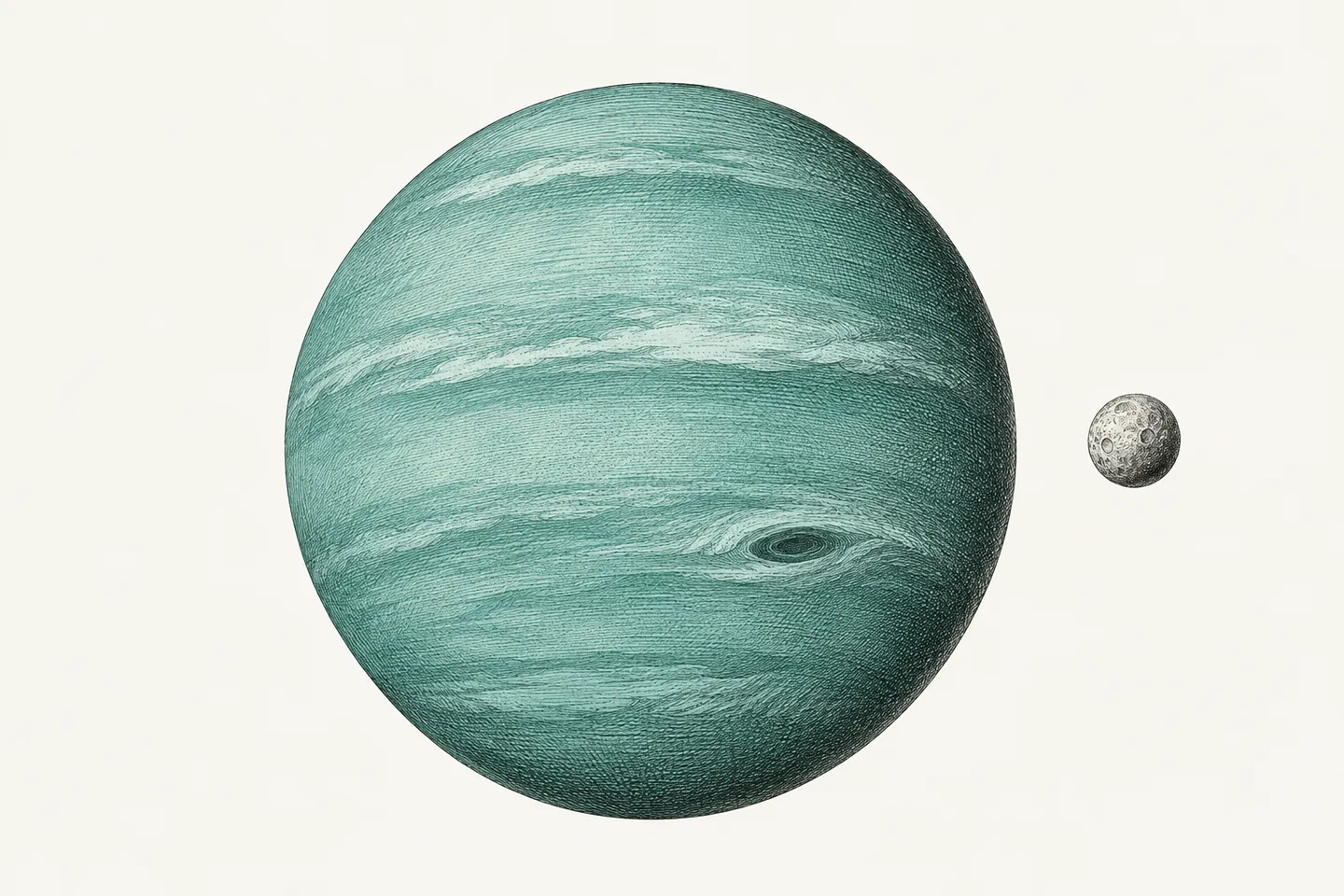
Neptune at a glance
- Symbol
- Neptune
- Kind
- Outer planet
- Rules
- Pisces
- Time in a sign
- 13.6 years
- Shortest to longest stay
- 13.1 years to 14 years
- Retrograde
- 42.8% of the time
- Turns a year
- 1 times
Cycle figures computed on November 9, 2026. The site's own ephemeris series, sampled every 2 days from 2000-01-01 to 2099-12-31 (6 complete stays in a sign). A stay runs from the first time the body reaches a sign's start to the first time it reaches the next sign's start, so a retrograde step back over a border is part of the stay. Retrograde means the ecliptic longitude is falling between two samples.
A faint, slow-moving planet
Neptune is an outer planet associated with imagination, ideals, compassion, intuition and blurred boundaries. It was discovered in 1846, after calculation pointed to its place before anyone saw it. The planet is too faint to see without a telescope. These details give Neptune a distinctive place in astrology: its meaning concerns subtle impressions, while its discovery began with inference rather than direct sight.
Neptune circles the Sun in about 165 years and stays about fourteen years in a sign. That slow pace means people born in the same period often share its sign placement. In a personal chart, Neptune is therefore linked with ideals and sensitivities that can mark a wider age group, as well as with more individual themes shown by its chart position.
Its modern sign connection
The traditional scheme does not cover Neptune because it is a modern planet. It has no traditional dignities, so there is no traditional sign where it is at home, exalted, in detriment or in fall. Modern astrology gives Neptune Pisces as its ruler. That association connects it with Pisces themes of receptivity, imagination, compassion and porous boundaries.
The same imaginative drive may look receptive and hard to pin down in Pisces, while in Virgo it may take a careful, analytical and practical form. Those are descriptions of sign manners, not traditional dignity labels for Neptune. Virgo is not assigned as Neptune’s traditional detriment or fall: the older dignity scheme does not give Neptune those statuses at all.
Imagination in daily life
In ordinary life, Neptune can be associated with daydreams, artistic imagination, compassion and intuitive responses. Its blurred-boundary theme may describe difficulty separating an ideal from what is actually present, or a wish to help that makes limits less clear. These are ways to reflect on experience, not predictions. Neptune’s slow movement also means its sign themes can be shared across a generation.
Neptune turns retrograde once a year, for about five months. In astrology, that period may be used to consider ideals, intuition and unclear boundaries from a more inward angle. It does not mean that a person’s imagination or compassion switches off, or that a particular event must occur. The retrograde label describes how the planet appears to move from Earth, and astrologers give that appearance a reflective meaning.
Questions
Why is Neptune called an outer planet in astrology?
Neptune is classed as an outer planet, and its long orbit sets it apart from faster-moving planets. It circles the Sun in about 165 years, spending about fourteen years in each sign. As a result, its sign can describe themes shared by people born in a similar period.
Why was Neptune found by calculation before anyone saw it?
Neptune was discovered in 1846. Its position was worked out by calculation before the planet was seen, and Neptune is too faint to see without a telescope. Astrology may use that history as an apt image for a planet associated with subtle impressions and intuition, though that is an interpretation.
Does Neptune have exaltation, detriment, or fall signs?
No traditional exaltation, detriment or fall signs are assigned to Neptune. The traditional dignity scheme does not include this modern planet. Modern astrology gives it Pisces as its ruler. That is a modern sign connection, not a set of traditional dignity statuses.
What does Neptune retrograde mean in a birth chart?
Neptune turns retrograde once a year, for about five months. Astrologers may read this as a period for inward attention to ideals, imagination and boundaries. The retrograde label describes apparent motion from Earth; it does not promise a change or event in someone’s life.
Find your Neptune
Enter your birth details to see Neptune in your chart: its sign, its house and whether it is retrograde.
Plate 1. Birth details
Example chart: 15 June 1990, 14:30, London (an invented birth, not a real person)
Plate 2. Find yours
Neptune in the example chart
This is the example chart. Enter your details above to see yours.
- Sign
- Capricorn
- Degree
- 13°43'
- House
- 3rd house
- Motion
- Retrograde
In sign
Neptune in Capricorn
Ideals and compassion may take a serious, duty-minded form, with imagination focused on what can be built over time. You may show care by taking responsibility, yet reserve can make your softer feelings less visible in daily life.
In house
Neptune in the 3rd house
Imagination often colors how you talk, learn, and take in everyday details. You may notice subtle meanings and respond with compassion, but assumptions can slip into conversations when facts feel unclear.