Uranus in the birth chart
In a birth chart, Uranus is associated with change, independence, surprise and originality. It can describe a drive to break from habit and try a different way. The sign it occupies shapes how that urge is carried out. Uranus is an outer planet, spending about seven years in each sign, so its sign is shared by many people born around the same time.
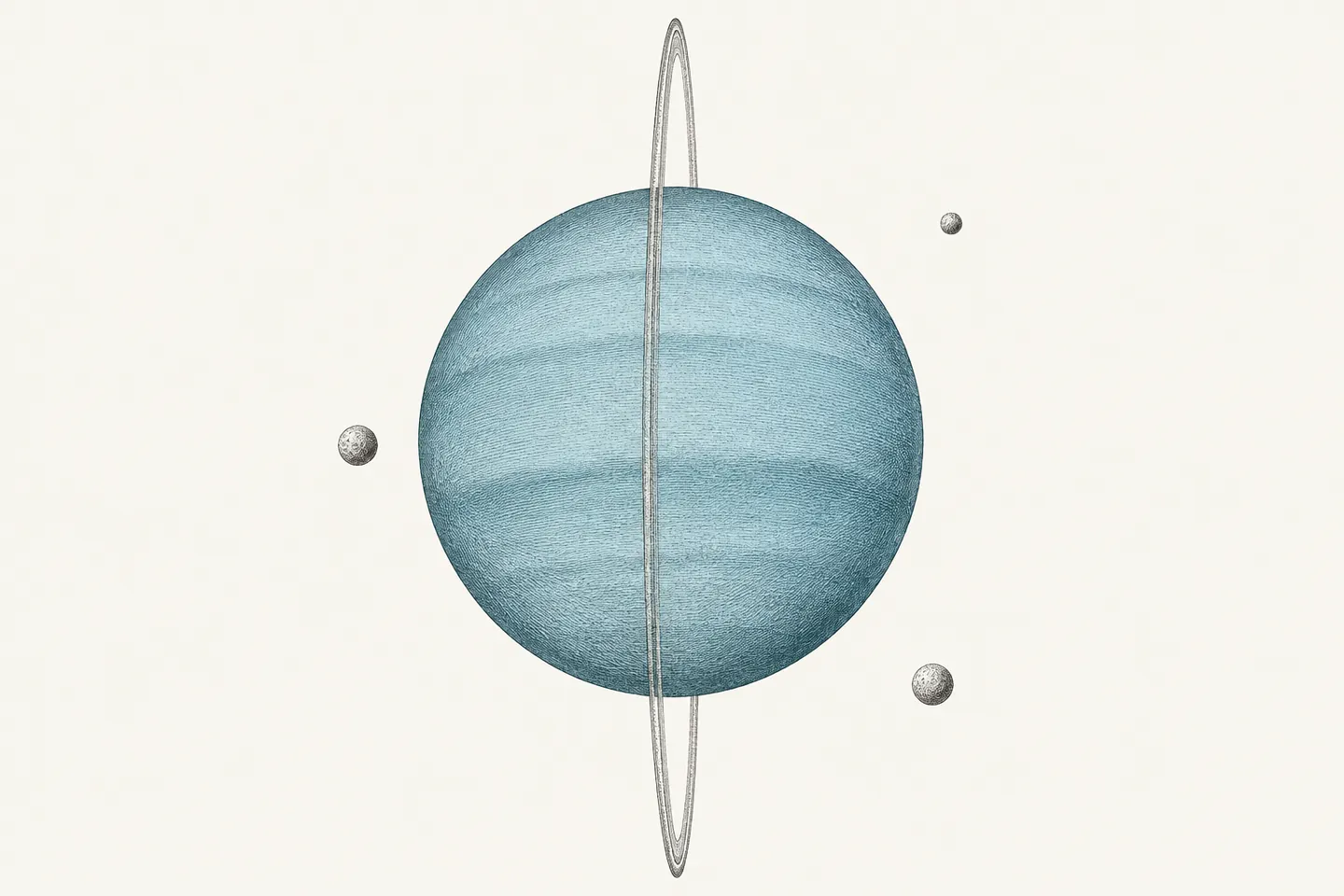
Uranus at a glance
- Symbol
- Uranus
- Kind
- Outer planet
- Rules
- Aquarius
- Time in a sign
- 7 years
- Shortest to longest stay
- 6.2 years to 8 years
- Retrograde
- 41.3% of the time
- Turns a year
- 0.99 times
Cycle figures computed on November 9, 2026. The site's own ephemeris series, sampled every 2 days from 2000-01-01 to 2099-12-31 (13 complete stays in a sign). A stay runs from the first time the body reaches a sign's start to the first time it reaches the next sign's start, so a retrograde step back over a border is part of the stay. Retrograde means the ecliptic longitude is falling between two samples.
An unusual planet in the sky
Uranus stands for change, independence, surprise, originality and breaking from habit. In a chart, it is associated with the urge to question what has become routine and to make room for a different approach. Its influence is often described as disruptive or sudden, though astrology treats that language as a way to reflect on patterns, not as a promise of events.
Its place in the sky is unusual: discovered in 1781, Uranus was the first planet found with a telescope, and it rolls around the Sun tilted on its side. It circles the Sun in about 84 years, staying about seven years in a sign. That long stay gives its sign a broad generational quality, while its personal expression is considered alongside the rest of a birth chart.
Modern rulership and sign strength
The traditional dignity scheme was set before Uranus was known, so it has no traditional home, exaltation, detriment or fall. Modern astrology gives Uranus rulership of Aquarius. In that modern scheme, Aquarius is its home sign, while Leo, the opposite sign, is its detriment. Modern astrologers do not agree on a standard exaltation or fall for Uranus, so those labels are not part of the traditional scheme.
A friendly sign can make Uranus's drive for change feel at ease, while an uncomfortable one can make it harder to express. For example, in Aquarius, its independent and inventive style may appear as an unconventional idea pursued with detachment. In Leo, where Uranus is in detriment in the modern scheme, the same wish to stand apart may feel caught between personal expression and resistance to being seen in an expected way.
Change in everyday life
In ordinary life, Uranus may show up as a preference for freedom, an interest in new methods, or impatience with a rule that no longer seems useful. It can describe how a person responds to surprise and where they seek room to experiment. Since Uranus remains in a sign for about seven years, its sign often speaks to a shared age group; the rest of the chart helps make its personal meaning more specific.
Uranus turns retrograde once a year, for about five months. In astrology, this period can be read as a time when its themes of independence or change are considered more inwardly, rather than as a forecast of disruption. Retrograde describes the planet's apparent motion from Earth. Uranus's slow orbit means its retrograde is a regular feature of its cycle, not a rare event in an individual's chart.
Questions
Why does Uranus stay in one zodiac sign for so long?
Uranus circles the Sun in about 84 years, so it spends about seven years in each sign. People born during the same stretch often share its sign. Astrologers therefore connect that placement with a generational tone, while looking to the full chart for a more personal reading.
What does Uranus retrograde mean in a birth chart?
Uranus turns retrograde once a year for about five months. Astrologers may read this as a more inward expression of its themes, such as independence or change. The apparent backward motion is part of its regular cycle and is not, by itself, a prediction of an unusual event.
Which sign is Uranus strongest in according to modern astrology?
Modern astrology gives Uranus rulership of Aquarius, so Aquarius is its home sign in that system. The traditional dignity scheme does not include Uranus because it was discovered later. Modern astrology also commonly treats Leo, opposite Aquarius, as Uranus's detriment.
Why is Uranus associated with independence and sudden change?
Astrology links Uranus with independence, surprise, originality and breaking from habit. Its unusual sideways tilt and its discovery as the first planet found with a telescope help explain why it is treated as distinct among the planets. These associations offer language for reflection, not proof or prediction.
Find your Uranus
Enter your birth details to see Uranus in your chart: its sign, its house and whether it is retrograde.
Plate 1. Birth details
Example chart: 15 June 1990, 14:30, London (an invented birth, not a real person)
Plate 2. Find yours
Uranus in the example chart
This is the example chart. Enter your details above to see yours.
- Sign
- Capricorn
- Degree
- 8°10'
- House
- 3rd house
- Motion
- Retrograde
In sign
Uranus in Capricorn
Fresh approaches to rules and responsibilities can mark Uranus in Capricorn. You may favor practical changes that serve a larger purpose, but a serious, dutiful streak can make it hard to loosen established plans.
In house
Uranus in the 3rd house
Original ideas are tied to how you communicate, learn, and connect with nearby people. You tend to speak or think in unexpected ways, which can make it harder to feel understood in routine conversations.